

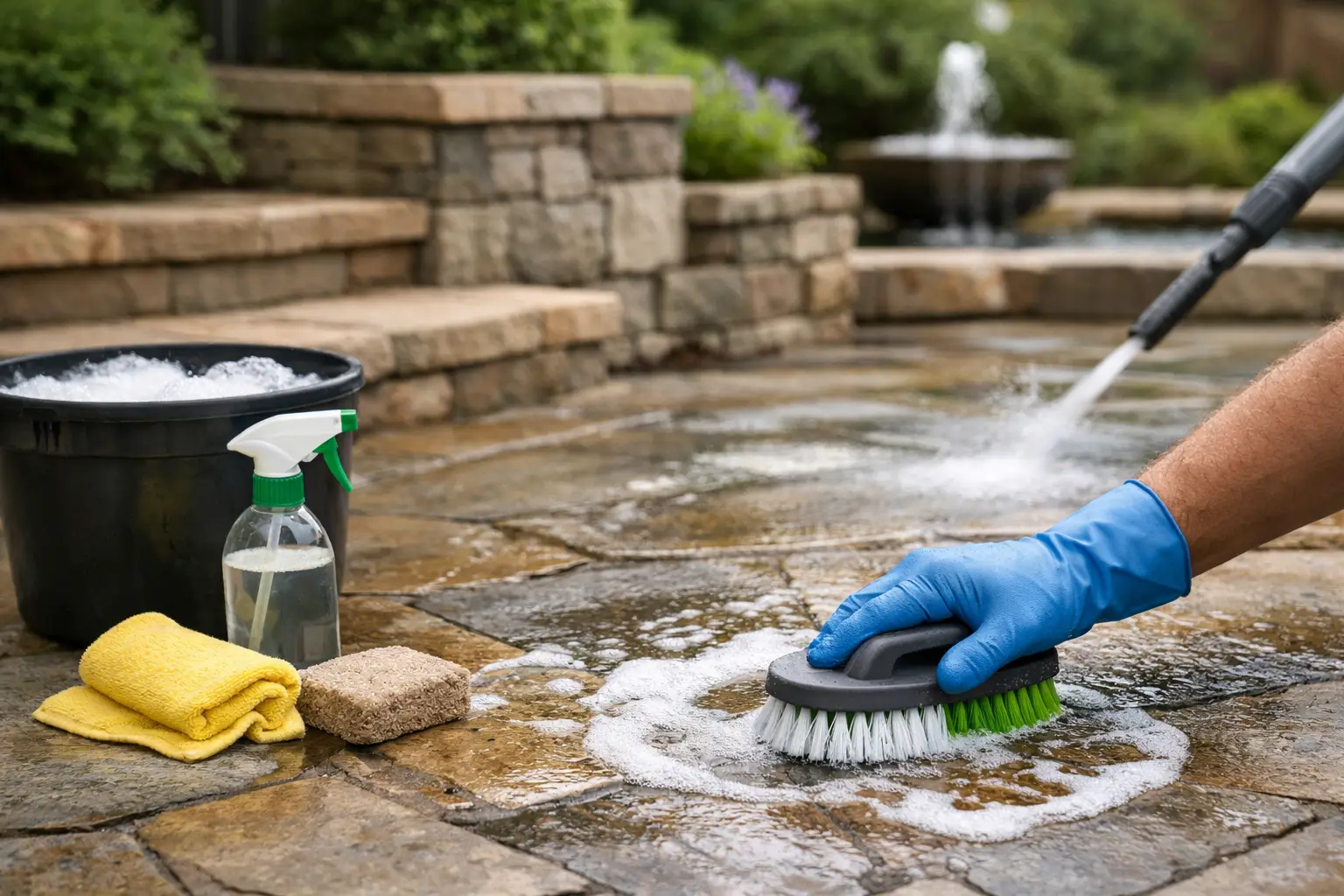
That dark patch on your sandstone path is rarely just dirt. Outside natural stone usually collects a mix of algae, mould, lichen, traffic grime and mineral staining, and each one reacts differently to water pressure and cleaning products. If you are looking for the best way to clean natural stone outside, the short answer is this: use the right pressure, the right treatment, and the right method for the specific stone.
That matters more than most property owners realise. Natural stone can look tough, but many outdoor surfaces are surprisingly easy to mark, etch, pit or fade if they are cleaned too aggressively. A quick blast with a high-pressure cleaner might remove the visible grime, but it can also strip out the surface, open the pores and make the stone more likely to stain again.
Why the best way to clean natural stone outside depends on the stone
Natural stone is not one material. Travertine, limestone, bluestone, slate, granite and sandstone all behave differently outdoors. Some are dense and hard wearing. Others are softer, more porous and far more sensitive to pressure and chemical exposure.
Sandstone is a common example. It looks great around homes and landscaped areas, but it can shed its face if it is hit with too much pressure. Travertine around pools can hold grime in its pores, yet harsh acidic products can damage the finish. Slate often has natural clefts and texture that trap organic growth, so it needs enough treatment to kill the growth without forcing water into weak points.
This is why there is no one-size-fits-all setting for outside stone cleaning. The safest approach is always to identify the stone first, then match the cleaning process to its condition, age and location.
What actually makes outdoor stone look dirty
On Southeast Queensland properties, the problem is often less about dust and more about moisture-related growth. Humid conditions, shade and poor drainage create ideal conditions for algae and mould. Pool areas can also collect sunscreen residue, body oils and mineral build-up. Driveways and pathways pick up tyre marks, leaf tannins, rust spots and general grime.
Some staining is only on the surface. Some gets deep into the pores. That difference changes how the area should be cleaned. If the issue is organic growth, the goal is not just to rinse it off. The growth needs to be treated properly, otherwise it often returns quickly.
The safest cleaning method for most outdoor natural stone
For most exterior natural stone, the best result comes from a low-pressure or controlled-pressure clean combined with the correct treatment solution. In practical terms, that usually means soft washing or a tailored surface cleaning process rather than using maximum pressure.
Soft washing is especially useful when the stone is porous, aged or installed in areas where appearance matters, such as entry paths, feature walls, courtyards and pool surrounds. The treatment does the heavy lifting by breaking down organic growth and loosening embedded grime. Water pressure is then used carefully to rinse and lift contamination without scarring the stone.
This approach is slower than simply turning the pressure up, but it is far better for surface preservation. It also tends to produce a more even result, because you are treating the cause of the staining rather than just removing what is visible at the top.
Best way to clean natural stone outside without causing damage
The biggest mistake people make is assuming more pressure means a better clean. On concrete, higher pressure can sometimes be acceptable in the right hands. On natural stone, especially softer stone, that logic often causes avoidable damage.
A safer process usually starts with an inspection. The surface is checked for loose pointing, cracked grout, spalling, existing sealers and any signs the stone has become friable. From there, a test patch helps confirm how the stone responds. If there is mould or algae, a suitable treatment is applied and given time to work. Only then is the surface rinsed with controlled pressure.
This matters on residential properties, but it matters just as much on strata sites, schools and commercial entries where large stone areas need to stay presentable for the long term. A cleaning method that looks fine on day one but shortens the life of the surface is not a cost saving.
Why acids and off-the-shelf products can be risky
Many hardware store cleaners promise fast results on outdoor stone. The issue is that natural stone can react badly to the wrong chemical, particularly if the product is acidic. Acid can etch calcareous stones such as limestone and travertine, leaving dull patches or permanent surface damage.
Even when a product does not visibly etch the stone, it can affect nearby grout, joints, metal fittings or surrounding landscaping. Bleach-heavy DIY mixes can also cause patchy results if they are too strong, not applied evenly or not rinsed correctly.
That does not mean all chemical treatment is bad. It means the product needs to match the surface and the staining. Professional cleaning relies on that balance – enough strength to treat growth and grime, but not so much that the stone is compromised.
Can you pressure clean natural stone outside?
Sometimes, yes. Blindly, no.
Pressure cleaning natural stone can be effective when the pressure is adjusted properly, the nozzle and distance are controlled, and the operator understands the surface. Harder stone in good condition may tolerate more than softer, weathered stone. Flat stone paving may respond differently from stacked stone walls or decorative cladding.
The risk with DIY pressure cleaning is not just obvious gouging. You can also leave wand lines, remove jointing sand, weaken mortar, force water behind stone faces or roughen the finish enough to attract faster re-soiling. Once that top layer is disturbed, the area may stay harder to maintain.
That is why experienced operators focus on surface-safe cleaning rather than brute force. At Boost Exterior Cleaning, that is the difference between cleaning for appearance only and cleaning for appearance plus preservation.
Pool areas, pathways and retaining walls need different treatment
One reason natural stone cleaning goes wrong is that people treat every outside area the same. A pool surround has different needs to a front path or a retaining wall.
Around pools, slip risk is a major factor. Algae needs to be removed thoroughly, but the stone also needs to retain its appearance and grip. On pathways, tannin stains from leaves and general foot traffic are more common. On retaining walls and vertical surfaces, run-off, irrigation overspray and trapped moisture can create heavy streaking and moss growth.
Each setting changes the best cleaning method. It also affects whether sealing should be considered after cleaning. Some outdoor stone benefits from sealing to help reduce moisture absorption and future staining, while some finishes are better left uncoated depending on the stone type and the look you want to maintain.
When DIY is reasonable and when it is not
If you have a small area of dense stone with light dirt only, a careful clean with mild stone-safe product, a soft broom and a gentle rinse may be enough. The key is to avoid acidic cleaners, avoid metal scrubbing tools, and avoid high-pressure blasting at close range.
DIY becomes risky when the stone is expensive, heavily stained, slippery with algae, close to glass or painted surfaces, or already showing wear. The same applies if you are cleaning a larger area where uneven results will stand out. In those cases, professional cleaning is usually the safer and more economical choice once you factor in the cost of repair or replacement.
How often should outdoor natural stone be cleaned?
It depends on the location and how exposed the surface is to moisture, shade and traffic. Pool surrounds and shaded pathways often need attention more often than sunny entertaining areas. Commercial and body corporate sites may also need a tighter maintenance cycle because presentation and safety are ongoing priorities.
As a general rule, once organic growth becomes visible, the surface is already more slippery and more vulnerable to deeper staining. Cleaning earlier is usually easier, safer and cheaper than waiting until the stone looks badly neglected.
A regular maintenance approach also helps preserve sealers, joints and the overall finish. That is especially useful for properties preparing for sale, lease turnover or routine presentation upgrades.
Natural stone adds real value to an exterior, but only when it is cleaned with some care. The best results come from treating the stone as a surface worth preserving, not just a stain worth removing. If you are unsure what your outdoor stone needs, the safest next step is to have it assessed properly before a pressure cleaner does more harm than good.


